
Tanghulu Master Recipes failures happen even when you follow every step exactly. You dried the fruit, cooked the sugar, and still ended up with sticky candy instead of that glass-shell crunch. So what went wrong?
Most tanghulu recipes skip what actually matters: moisture control, sugar stage, and fruit compatibility.
That’s what this Tanghulu Master Recipes guide fixes — with a fruit ranking, no-thermometer method, and troubleshooting guide to help you make tanghulu that actually crunches.
Why These Tanghulu Master Recipes Work So Well
Most tanghulu tutorials treat the recipe like a three-step magic trick. Boil sugar. Dip fruit. Done. But anyone who’s made a sticky batch knows it’s more nuanced than that.
These recipes work because they do something competitors don’t: they explain the why behind every step.
- Fruit selection is 80% of the battle. The wrong fruit — even prepped perfectly — will melt your coating from the inside. This guide ranks 8 popular fruits by moisture content and surface texture so you choose the right one before you touch a burner.
- Temperature is the only variable that matters. Hard crack happens at exactly 300°F (150°C). One degree too low and you get gummy candy. One degree too high and you get burnt caramel. We cover both the thermometer and the no-thermometer method.
- Troubleshooting is built in. Sticky? Grainy? Won’t harden? Every failure mode is explained with a real fix — not just “try again.”
- Dietary versions that actually work. The keto version uses allulose — the only sugar substitute that genuinely reaches hard-crack stage without a chalky finish.
What Is Tanghulu? The TikTok Snack With a 1,000-Year History
Before you fire up the stove, it helps to understand what you’re actually making. And for a snack that’s gone viral on every social platform, tanghulu has a surprisingly deep backstory.
Chinese Origins: Bingtanghulu and the Hawthorn Berry Tradition
Tanghulu — or bīngtánghúlu (冰糖!, 浮) in Mandarin — has been sold on Beijing streets since the Song Dynasty, around 900 years ago. Originally, it was made with shanzha (hawthorn berries): small, intensely tart red fruits that balance the sweetness of the hard sugar shell perfectly.
Street vendors would skewer 5 to 9 berries on a thin bamboo stick, dip them in boiling rock sugar syrup, and set them in the winter cold. The freezing air was the original “ice bath.” Today, that cold-shock step is replaced by a bowl of ice water — but the chemistry is identical.
How TikTok and Korean Street Food Culture Made Tanghulu Go Global
The modern tanghulu craze didn’t come from China — it came from South Korea, where the snack became a street food sensation around 2021 and exploded on TikTok shortly after. Korean vendors started making tanghulu with strawberries and grapes instead of hawthorn berries, which are hard to find outside of Asia. That swap made tanghulu instantly accessible for home cooks everywhere.
So is tanghulu Chinese or Korean? Both, honestly. The recipe and technique are Chinese. The modern viral format — fruit variety, ASMR crunch content, strawberry-first aesthetic — is Korean. Our recipes honor both traditions.
Why That ASMR Crunch Is the Whole Point
That sharp, glass-like crack when you bite through the shell? It’s not just satisfying — it’s the literal proof that the sugar coating reached hard-crack stage and set properly. If you don’t get that crunch, the coating didn’t reach temperature. That sound is your quality indicator. It’s also, not coincidentally, why tanghulu racked up tens of millions of views on ASMR cooking channels worldwide.
The Tanghulu Fruit Ranking — Not All Fruits Are Equal
This is the section most recipes skip entirely, and it’s the one that saves you the most frustration.
The Moisture Problem: Why Some Fruits Destroy Your Candy Coating
Sugar syrup at hard-crack stage is essentially dehydrated. It has almost zero water content inside. When it hits fruit, it needs a bone-dry surface to adhere to — any residual moisture on the skin creates a barrier that prevents proper bonding.
But here’s what most recipes don’t mention: some fruits are internally too wet. Even after drying the outside perfectly, highly juicy fruits will slowly release moisture from the inside out, dissolving the candy shell from beneath. That’s the real reason your tanghulu goes sticky after 10 minutes — the coating is being attacked by the fruit’s own juice.
Tier 1 Fruits — Best for Tanghulu
These fruits have firm flesh, relatively low moisture at the surface, and a tart flavor that contrasts beautifully with the sweet shell.
- Fresh strawberries — The gold standard. Hull them, dry them completely, and they hold a perfect coating for 30 to 40 minutes.
- Seedless green grapes — Firm, low surface moisture, naturally tart. Green grapes outperform red ones because they hold their shape better under heat.
- Hawthorn berries — The traditional choice. Tart, dense, and practically built for tanghulu. They’re harder to find, but worth sourcing from Asian grocery stores if you want the authentic experience.
Tier 2 Fruits — Works Well With Proper Prep
These fruits work but require extra attention to drying. Pat them down twice, and let them air dry for an additional 5 minutes after toweling.
- Mandarin orange segments — Remove all white pith and membrane. Any pithy residue will trap moisture and corrupt the seal.
- Blueberries — Small and firm, but their waxy skin can make coating adhesion slightly tricky. Dry thoroughly and dip with a quick, decisive motion. If you love working with blueberries, you’ll also enjoy our Blueberry Cream Cheese Bread — a completely different flavor profile, but worth bookmarking.
- Kiwi slices — Slice thick (at least ¾ inch) and pat very dry. The acidity gives a wonderful contrast.
Tier 3 Fruits — Proceed With Caution
- Cherries — High moisture content. They work if you keep them refrigerator-cold before dipping and eat immediately after.
- Raspberries — Too delicate. The cavity in the center traps air and causes the coating to crack. Keep your pieces to under three per skewer.
Fruits to Avoid Completely
Don’t use watermelon, pineapple, or peach slices. All three have surface moisture levels so high that the sugar coating will either refuse to adhere or dissolve within minutes. This is also the answer to the common online question: “I wasted an entire watermelon trying to make tanghulu — why did it fail?” Moisture content. Every time.
One more thing before you start cooking: a reliable candy thermometer eliminates 90% of all tanghulu failures. The ThermoPro TP03 (~$19 on Amazon) reads instantly and clips to the side of your pot without any fuss — it’s the tool I reach for every single time.
Tanghulu Master Recipes — Step-by-Step
The Ingredients You’ll Need
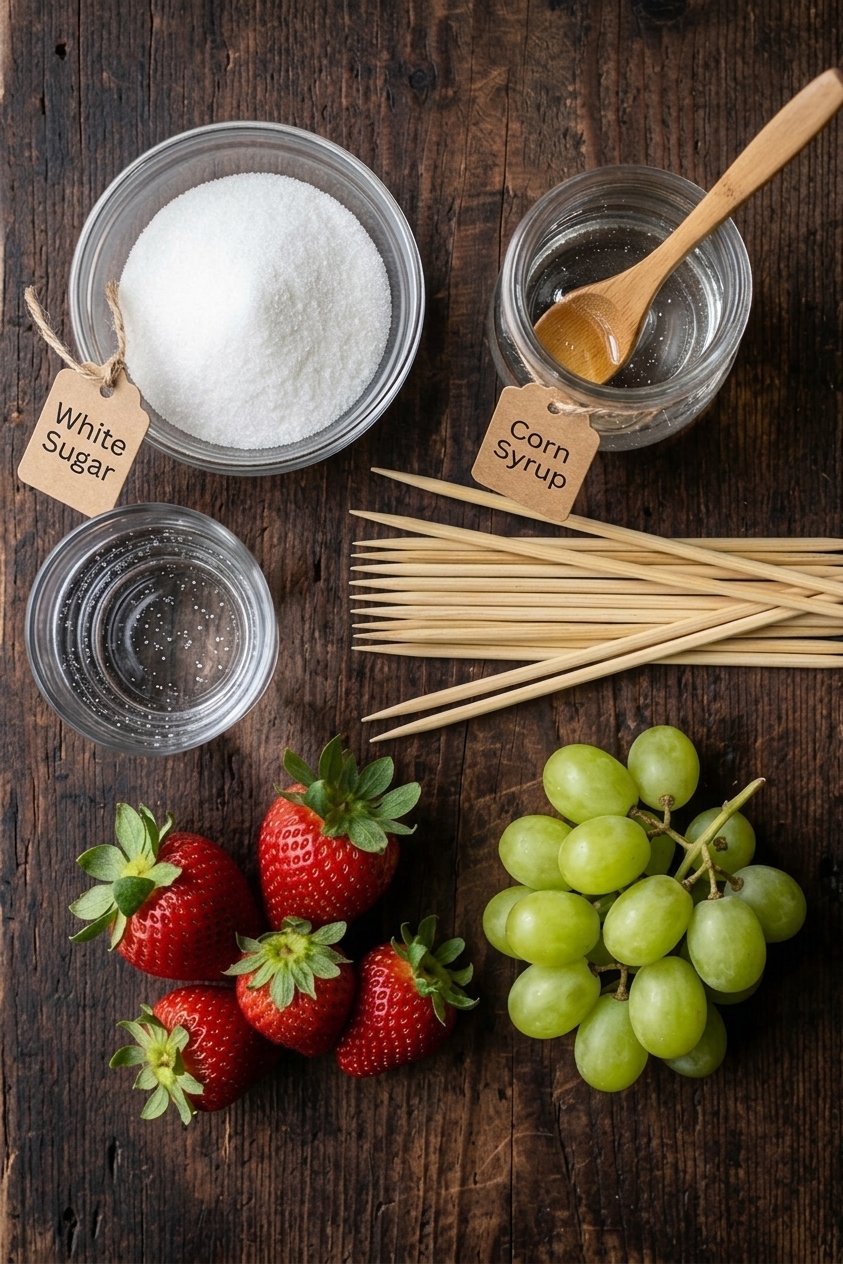
The Sugar Coating
- 1½ cups (300g) granulated white sugar — Use standard white granulated sugar, not raw cane sugar or turbinado.
- ¾ cup (180ml) cold water — The 2:1 ratio (sugar to water) is the gold standard.
- 1 teaspoon light corn syrup (optional) — Add this before heating. It prevents crystallization by interrupting sucrose chain formation.
The Fruit (Choose Tier 1 or Tier 2 from the ranking above)
- 1 cup (150g) fresh strawberries, hulled — Pat bone dry. Let air dry for 5 minutes after toweling.
- 1 cup (150g) seedless green grapes — Remove stems completely. Dry thoroughly.
- Optional additions: Mandarin orange segments, blueberries, thick kiwi slices — all must be completely dried.
Equipment
- Small stainless steel saucepan (2-quart). Not enamel-coated — enamel holds uneven heat and dramatically increases crystallization risk.
- Candy thermometer (clip-on style preferred)
- 8–12 bamboo or wooden skewers
- Large bowl of ice and cold water
- Parchment paper or silicone baking mat
Step 1: Prep the Fruit (This Step Makes or Breaks Everything)
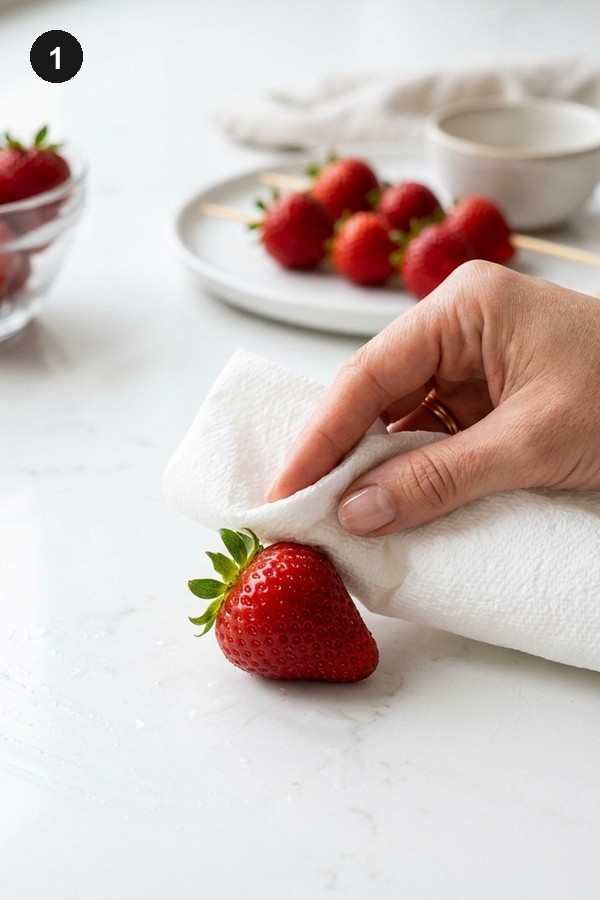
Wash your fruit gently under cool water. Then towel-dry each piece completely with paper towels. Don’t rush this. Once they’re toweled, set them on a clean dry tray and let them air-dry for 5 more minutes. Any moisture — even microscopic — will cause the sugar to bead up and slide off the fruit instead of adhering.
Thread 1 to 3 pieces of fruit per skewer. Keep them snug but not crowded. More than three pieces makes the skewer awkward to dip smoothly, and you need a fast, decisive motion when the time comes. Once skewered, line them on the parchment tray and set it right next to the stove.
Step 2: Set Up Your Ice Bath
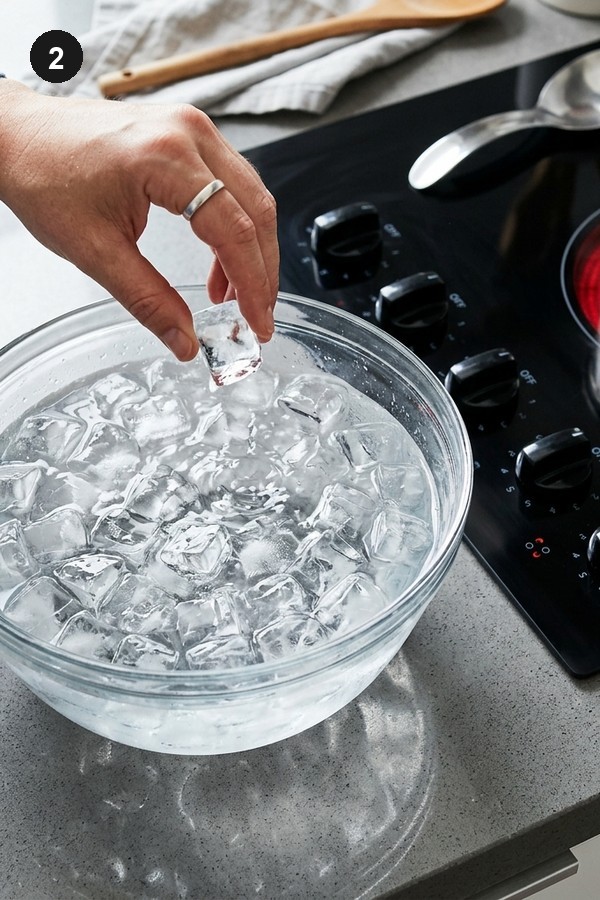
Fill a large bowl with ice and cold water — plenty of both. Place it within arm’s reach of your burner. You’ll be moving hot skewers from syrup to ice bath in under two seconds, so your setup matters. This isn’t a step you want to scramble for mid-dip.
Step 3: Combine Sugar and Water — Then Leave It Alone
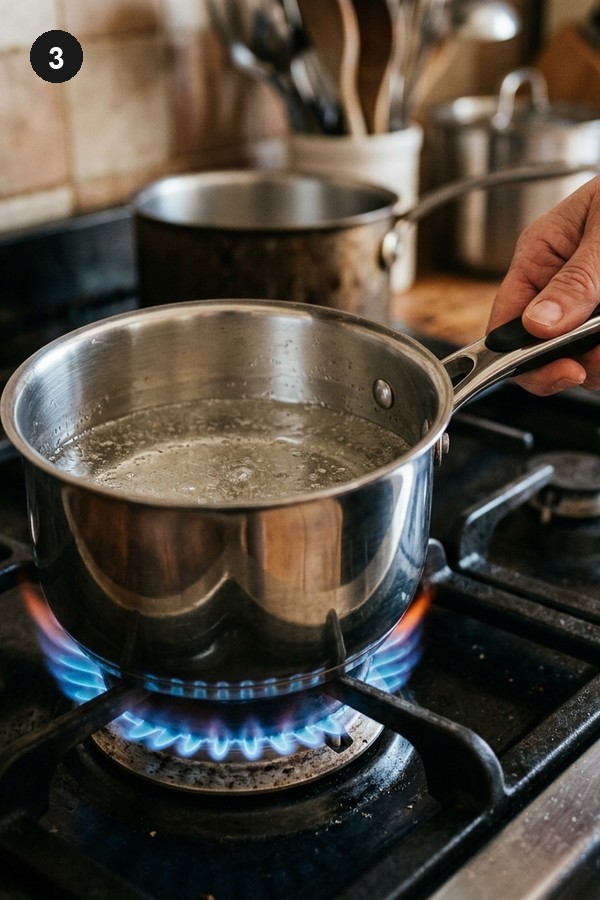
Pour the sugar and water into your stainless steel saucepan. If you’re using corn syrup, stir it in now — this is the only moment stirring is allowed. Once combined, place the pan over medium-high heat and do not touch it again. Trust me on this: no stirring, no tapping the pan sides with a spoon, no thermometer touching the bottom. Clip your candy thermometer to the side so it reads the temperature without contact.
Step 4: Cook to 300°F — Watch Carefully at the End
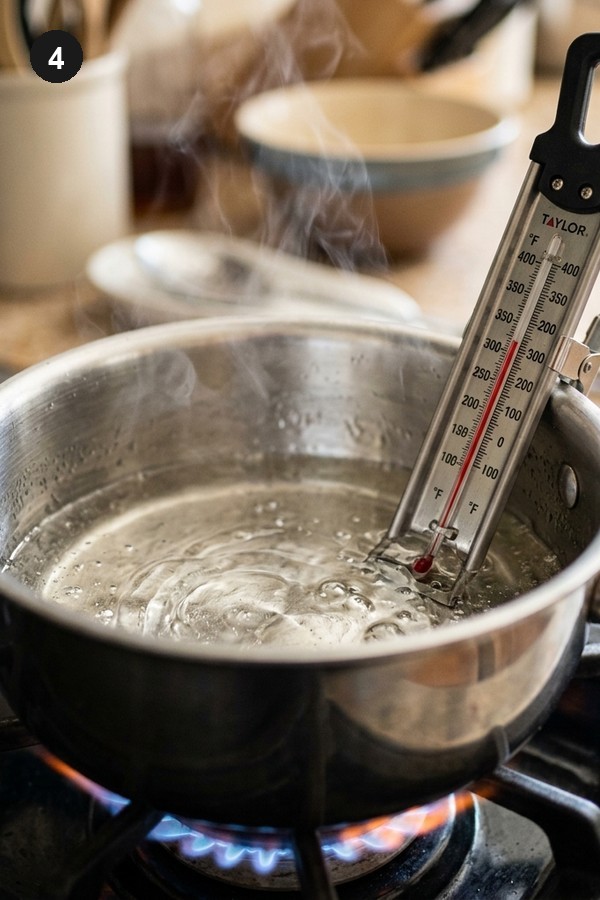
Cook over medium-high heat. For the first 10 minutes, the syrup will bubble vigorously and look milky-white — that’s the water still evaporating. Then it’ll clear. Then it’ll start to tinge faintly golden around the edges of the pan. That’s when you know you’re close. Watch your thermometer closely after 280°F — it climbs fast in the final stretch. Pull the pan off the heat at exactly 300°F (150°C).
Step 5: Dip the Fruit — Fast and Decisive
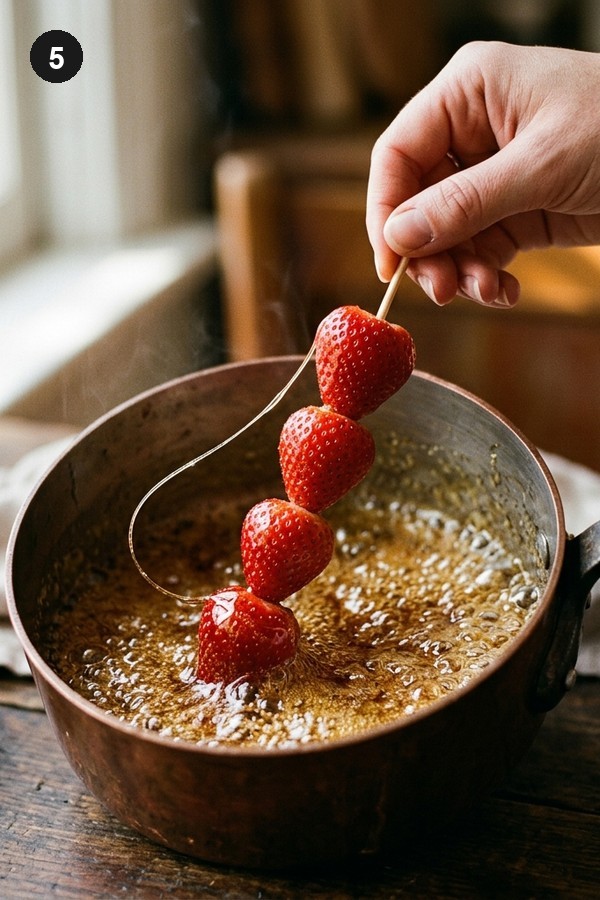
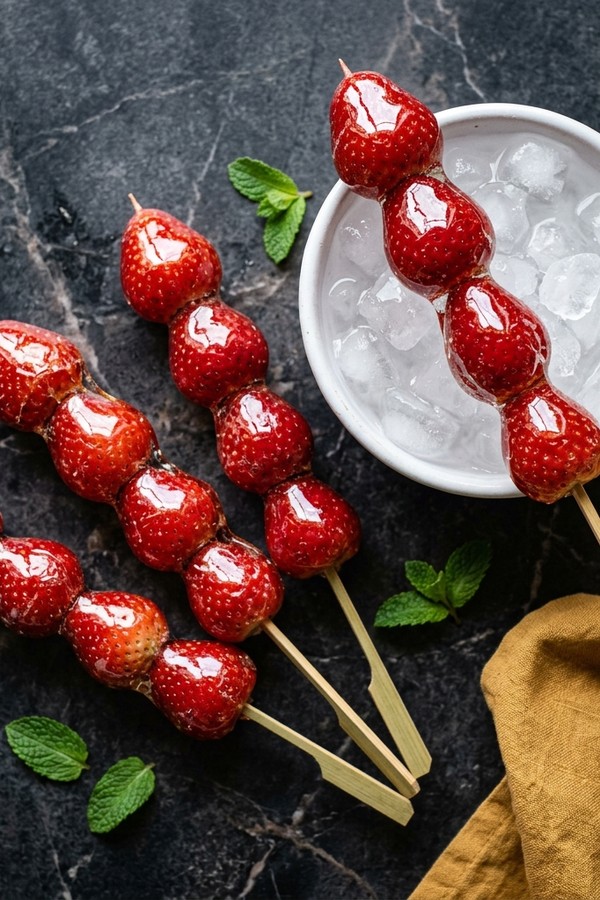
Tilt the saucepan slightly so the syrup pools to one side. Dip each skewer in with a smooth, swirling motion, coating the fruit in one continuous pass. You want a thin, even layer — not a heavy glob. Think glass, not candy apple. (Thin is everything here — a thick coating won’t harden evenly.) Then lift it out and let the excess drip back for a half-second.
Step 6: Ice Bath Shock
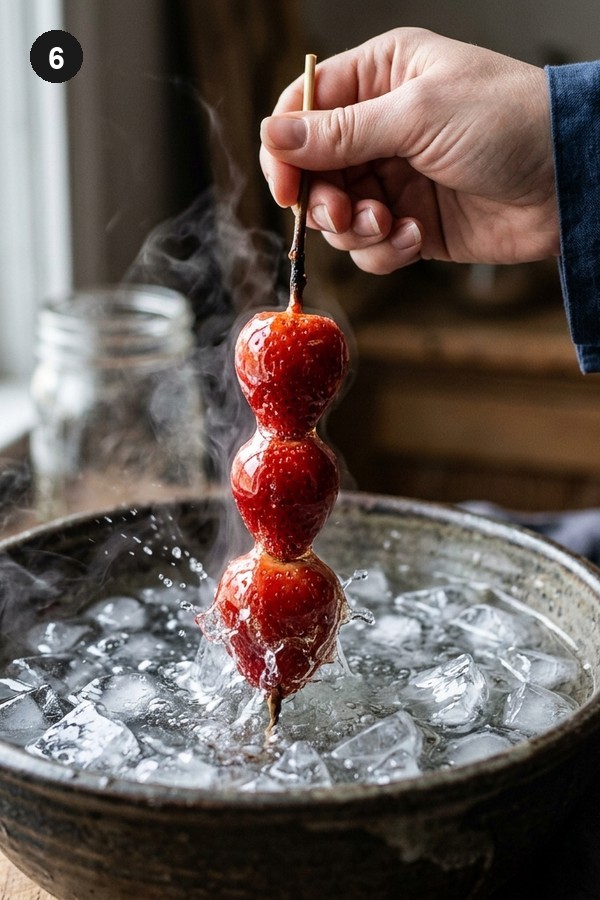
Immediately plunge the coated skewer into the ice water. Hold it there for 3 to 5 seconds. You’ll hear a satisfying sizzle and feel the shell harden under your fingertips. That’s the hard-crack stage locking in. The contrast between the 300°F syrup and the near-freezing water is what creates the glass-like snap.
Step 7: Set and Serve — Right Now
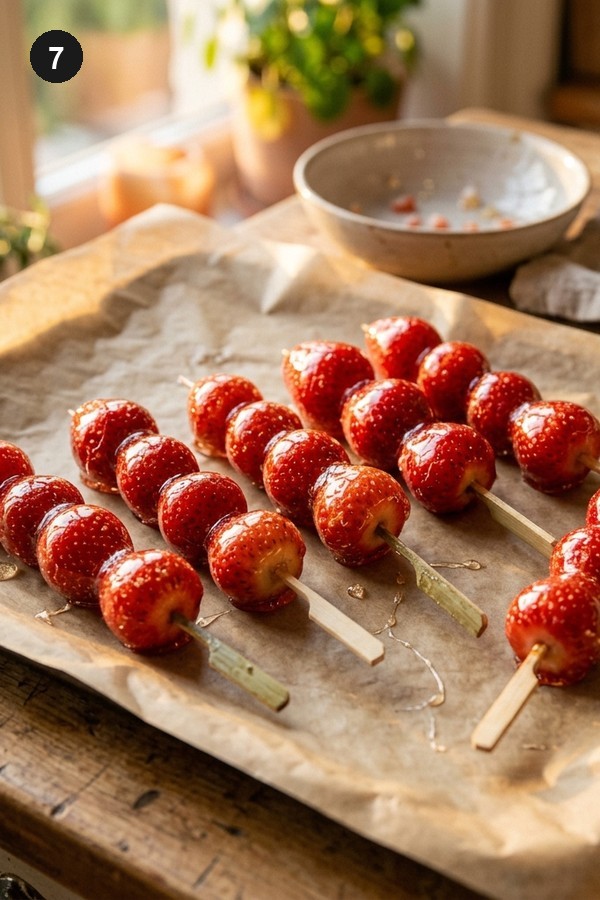
Lay the finished skewer on your parchment-lined tray and repeat with the next one. Work through all your skewers while the syrup is still hot enough to coat easily. Serve immediately — within 20 to 30 minutes. The candy coating will begin softening as the fruit releases moisture from the inside.
That’s the built-in expiration: tanghulu is a “make and eat” food, not a “make and store” food. Plan accordingly.
Customizing Your Tanghulu
Keto and Sugar-Free Tanghulu with Allulose
Here’s the truth about keto tanghulu: most sugar substitutes don’t work. Erythritol and monk fruit blends re-crystallize at cooler temperatures and produce a chalky, grainy coating that doesn’t snap properly.
Allulose is different. It behaves almost identically to sucrose at high temperatures — it caramelizes, it reaches hard-crack stage, and it hardens into a genuinely glass-like shell. Substitute it 1:1 for the granulated sugar in this recipe. Anthony’s Allulose works well and is widely available online.
For the keto version, stick to Tier 1 fruits: strawberries, raspberries, and blackberries all come in low enough in net carbs to keep the snack diet-friendly. The process is identical — just use allulose instead of sugar and monitor temperature the same way.
Kid-Safe Version
The syrup reaches 300°F — that’s hot enough to cause serious burns. For families with young children, keep kids out of the kitchen during the cooking step. Let an adult handle all the dipping. The finished tanghulu, however, is perfectly fine for kids to eat. Just make sure the candy shell has fully set and cooled (about 5 minutes) before handing skewers to little ones.
Vegan Confirmation
No changes needed. Tanghulu is entirely plant-based — just sugar, water, and fruit. It’s naturally gluten-free and dairy-free as well.
Tanghulu Troubleshooting Guide
Why Is My Tanghulu Sticky?
Five causes, in order of likelihood:
- Temperature too low. The syrup didn’t reach 300°F. Next time, trust the thermometer and wait.
- Fruit wasn’t dry enough. Surface moisture prevents the coating from bonding correctly.
- Humidity in the room. Tanghulu made on a very humid day will soften faster. Work in an air-conditioned space if possible.
- Coating is too thick. A heavy layer holds moisture against the fruit. Aim for thin.
- Waited too long to eat. Even perfect tanghulu softens after 30 to 40 minutes. There’s no remedy for this — serve it faster.
Why Is My Coating Grainy or Cloudy?
Crystallization. You stirred the syrup at some point during cooking, or a drop of water (condensation, steam, a wet spoon) fell into the pot. Start over with a clean pan, and this time don’t touch it.
Also check: did you use raw cane or turbinado sugar? Those varieties contain trace minerals that actively encourage re-crystallization. Use plain white granulated sugar only.
Why Won’t the Sugar Harden?
It didn’t reach hard-crack stage. If your skewer comes out sticky even after the ice bath, the syrup was likely at soft-crack or hard-ball stage — not quite there. Put the pan back on the heat, watch the thermometer, and cook to 300°F before dipping again.
How to Clean the Pan (Without the Scrubbing Nightmare)
Don’t chip at hardened sugar. Fill the pan with water and set it back on the stove over medium-low heat. Let it simmer for 5 to 8 minutes — the water will slowly dissolve the hardened sugar and you’ll be able to pour it down the drain. Repeat once if needed.
What to Do With Leftover Sugar Syrup
If you have syrup remaining in the pan, don’t waste it. Pour it slowly onto a parchment sheet (a silicone mat works even better) and add a pinch of flaky sea salt. Let it harden completely — you’ve just made homemade candy bark. You can also thin the remaining syrup with a splash of warm water to turn it into a light simple syrup for lemonade or cocktails.
How Long Does Tanghulu Stay Crunchy?
Realistically, 20 to 30 minutes at room temperature. In a cool, dry environment (air conditioning, low humidity), you might stretch to 40 minutes. Refrigerating tanghulu actually makes it worse — the condensation from the cold environment destroys the coating almost immediately.
What to Serve With Tanghulu
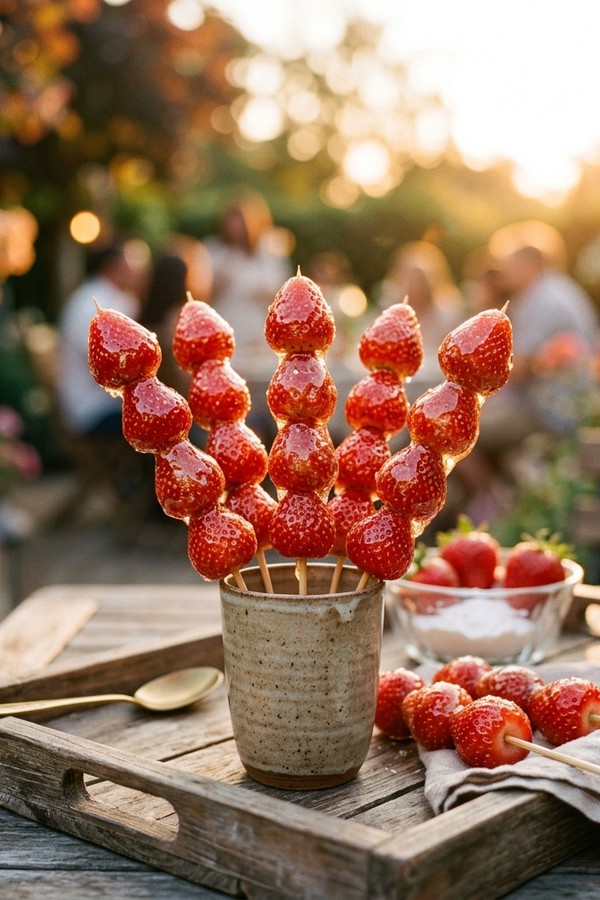
Tanghulu is best enjoyed as a sweet snack or dessert — bright, crunchy, and made for sharing. Here’s what pairs naturally with it.
Drinks
- Jasmine green tea or oolong — the floral bitterness cuts beautifully through the sugar shell
- Fresh lemonade or yuzu soda — the citrus acidity lifts the sweetness without competing with it
- Warm hojicha or barley tea — earthy and mild, a calming contrast to the bright fruit flavors
- Cold brew black coffee — the bitterness makes the fruit inside the candy shell pop
Sweet Pairings
- Homemade Lemon Crumb Bars — the sharp citrus tartness is a natural counterpoint to the tanghulu sugar shell; serve both on the same dessert board
- Blueberry Cream Cheese Bread — slice it thin and serve alongside tanghulu for a fruit-forward dessert spread that works beautifully at brunch or a casual gathering
Simple & Classic
- Fresh fruit platter — keep it simple with extra strawberries and grapes so guests can compare the candied vs. plain versions side by side
- Vanilla ice cream — the cold creaminess against a warm, just-made tanghulu is an unexpectedly wonderful combination
Any of these work — but honestly, a few skewers of tanghulu and a good cup of tea is all you really need.
Nutrition Info
These are estimates based on 2 skewers (approximately 1 serving, using strawberries and grapes, with standard sugar coating). Actual values vary depending on fruit size and coating thickness.
| Calories | ~180 kcal |
| Carbohydrates | ~46g |
| Fat | ~0g |
| Protein | ~0.5g |
| Sugar | ~44g |
| Fiber | ~1g |
| Sodium | ~2mg |
Common Questions and Easy Fixes
1. What is tanghulu made of?
Just three things: granulated white sugar, water, and fresh fruit on bamboo skewers. Optional: one teaspoon of corn syrup to prevent crystallization.
2. Is tanghulu Chinese or Korean?
Originally Chinese — the recipe dates back around 900 years to Beijing street markets. The modern viral format with strawberries and grapes came through South Korean street food culture and went global via TikTok.
3. Can you make tanghulu without a candy thermometer?
Yes. Drop a small amount of hot syrup into ice water after about 15 minutes of cooking. If it hardens instantly into a brittle bead that cracks when pressed, you’re at hard-crack stage and ready to dip.
4. How do you store tanghulu overnight?
You don’t, really. The candy shell softens within 30 to 40 minutes as the fruit releases moisture — there’s no reliable way to preserve the crunch overnight.
5. Why does my tanghulu turn sticky even right away?
The syrup didn’t reach 300°F, or the fruit surface wasn’t completely dry before dipping. Either issue creates a coating that never fully sets and immediately attracts moisture from the air.
6. Is tanghulu healthy?
It’s a treat — the fresh fruit adds some vitamins and fiber, but the candy coating is pure sugar. The keto version with allulose cuts that impact significantly.
Tanghulu mastery comes down to two things: choosing the right fruit and respecting the temperature. Once you understand both, the recipe stops feeling like a gamble. You’ll know exactly why each step matters — and when something goes wrong, you’ll know how to fix it without starting from scratch.
If you loved making these tanghulu master recipes, bookmark the page — it’s worth coming back to when strawberry season hits its peak.
More Recipes You’ll Love
🔥 Don’t Miss: Homemade Lemon Crumb Bars – buttery, tangy bars with a perfect crumb topping
🔥 Don’t Miss: Blueberry Cream Cheese Bread – soft, fruity bread swirled with cream cheese filling
Ingredients
Method
- Wash fruit gently and pat completely dry with paper towels. Let air-dry for 5 additional minutes. Thread 1 to 3 pieces per skewer and place on a parchment-lined tray beside the stove.

- Fill a large bowl with ice and cold water. Place within arm's reach of your burner.
- Combine sugar, water, and corn syrup (if using) in a stainless steel saucepan. Place over medium-high heat. Do not stir. Clip candy thermometer to side of pot.
- Cook without stirring until syrup reaches exactly 300F (150C), about 15 to 20 minutes. Watch closely after 280F it climbs fast. Remove from heat immediately at 300F.
- Tilt pan so syrup pools to one side. Dip each skewer in a smooth, continuous swirling motion to coat thinly and evenly. Let excess drip for half a second.
- Immediately plunge coated skewer into ice water for 3 to 5 seconds until candy shell is fully hardened.
- Transfer to parchment-lined tray. Repeat with remaining skewers. Eat within 20 to 30 minutes for maximum crunch.